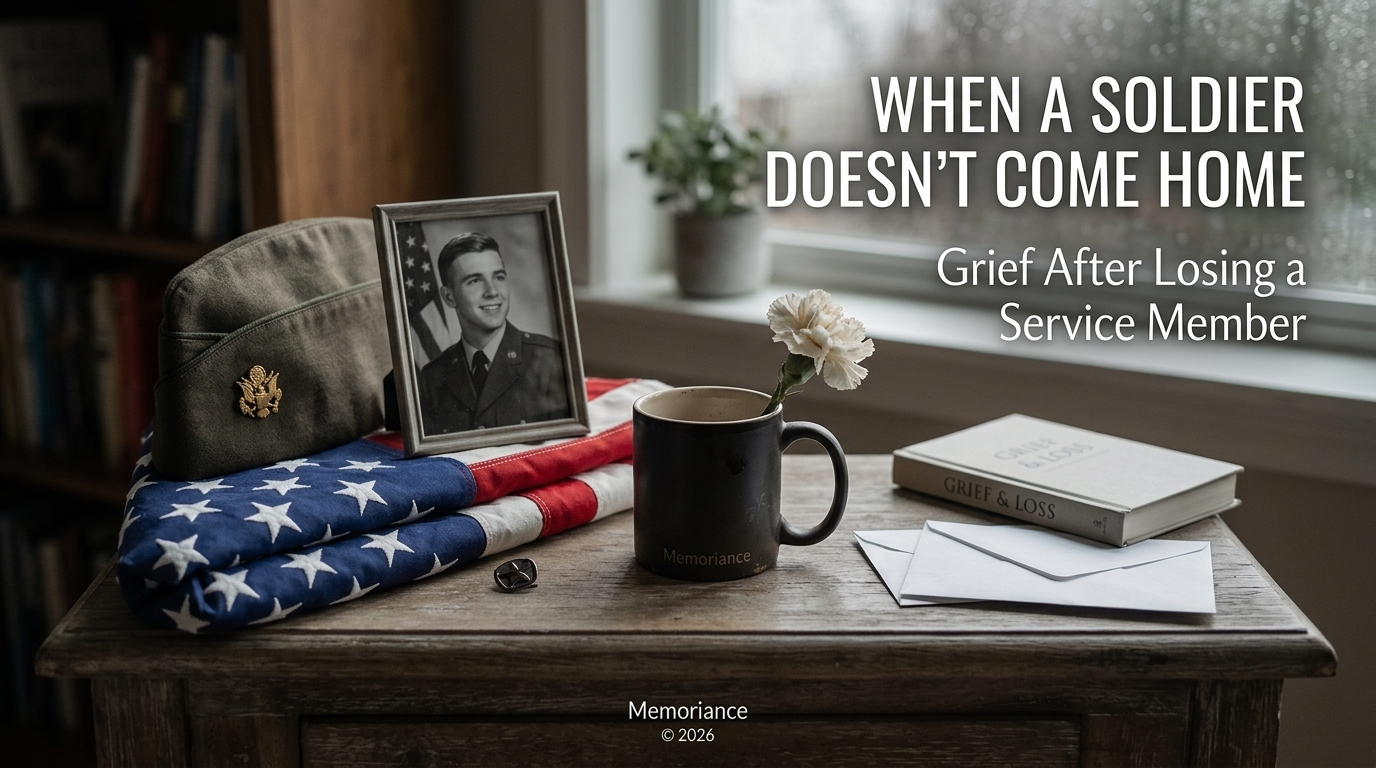
The knock at the door. Two uniformed officers standing on your step. The words that follow — words you knew were possible, that you trained yourself never to think about — and then silence where your world used to be.
Military loss is one of the most specific forms of grief a person can face. It carries everything that any sudden, traumatic death carries: shock, devastation, a future erased in an instant. And it carries things that are entirely its own.
Why Military Grief Is Different
When a service member dies in war or in the line of duty, the loss does not happen in isolation. It happens inside a machinery of service, sacrifice, and national meaning that can make grief both more complicated and more isolating.
You are grieving a person — a specific, irreplaceable human being who had a sense of humor, a way of laughing, a specific warmth when they hugged you. But the world tends to grieve something more abstract: a fallen hero, a symbol, a sacrifice.
The gap between those two things — the person you knew and the role they held — is one of the most disorienting features of military bereavement. You are expected, often simultaneously, to carry private grief and public pride. Neither leaves much room for the other.
The death was chosen — or was it?
Military service is a voluntary act in most countries. That fact is a complicated one for the bereaved. Some families find comfort in it: their person made a deliberate, courageous choice, and they died living by their values. Others find it a source of anguish — a door that should never have been opened, an enlistment form that felt, in retrospect, like a death warrant.
Neither response is right or wrong. Both are honest. The thought they didn't have to go and the thought they went because they believed in something can exist in the same heart at the same time, pulling in opposite directions.
Anger with nowhere to go
Military loss is frequently shot through with anger: at the military, at the government, at the decision-makers who deployed their person to that place at that time. For some families, this anger is clarifying and eventually galvanizing. For others, it becomes a place to live — a way of staying close to the loss without having to sit inside the grief itself.
Anger is a normal and recognized part of grief — not a sign that something is wrong with you. But when anger becomes the dominant and permanent mode, it can block the slower, more painful work of processing what's really there underneath it.
The loss happened far away
Most bereaved people can, with time, piece together what happened to their loved one. Military death is often different. The exact circumstances may be classified, contested, reported imprecisely, or simply unknowable from a distance. Families sometimes receive only fragments of the story — or a version of events that doesn't fully add up.
Grief without full information is a particular kind of suffering. The mind goes searching for the pieces, replaying possibilities, unable to close around something solid. This is sometimes called traumatic uncertainty, and it is a known complicating factor in military bereavement.
What Military Grief Actually Feels Like
The shape of grief after military loss often follows a pattern that is disorienting for the bereaved because it doesn't match the quiet, domestic picture of bereavement that our culture tends to project.
Numbness, then waves. The official notification is usually followed by a period of structured activity — the return of the body, military funeral arrangements, official correspondence. The rituals can hold grief at a functional distance. When the ceremony ends and the visitors go home, the grief often hits its full weight for the first time.
Pride and devastation, simultaneously. Many families describe a feeling of being internally split: deeply proud of their person's service and courage, and equally devastated that the service is what took them. These two truths don't cancel each other out. Grief is rarely clean.
Guilt about what you said (or didn't say) before the last deployment. The last conversation. The argument that was never resolved. The things you held back because there would be time later. This dimension of grief — the replaying, the "what if," the inventory of things left unsaid — is common to all sudden loss, but military families often carry it with an additional weight: the deployment was a known risk, and yet life continued normally around it.
A sense of living outside the civilian world. Families of service members often describe a sense of distance from people whose lives have not touched military loss. The references don't connect. The scale of what happened doesn't translate. This can deepen isolation, which is one of the factors that makes military grief more prone to becoming complicated over time.
Gold Star Families: A Name for What You Are Now
In the United States — and in many other countries with similar traditions — families who lose a service member in active duty receive official designation. In the U.S., they become Gold Star families, a term that dates to World War I.
The designation carries legal recognition, specific benefits, and a community of people who share the specific experience of military loss. It also carries something harder to define: a formal acknowledgment that what happened to your family is real, significant, and not forgotten by the institution that asked your person to serve.
Connecting with other Gold Star families — through organizations like TAPS (Tragedy Assistance Program for Survivors) in the U.S., or equivalent organizations in other countries — is consistently cited by bereaved military families as one of the most valuable forms of support available. Being understood by people who do not need things explained is its own form of relief.
The Phrase "They Died Serving Their Country"
You will hear this phrase many times. From officials, from well-meaning strangers, at the ceremony, in the coverage. It is meant as an honor. Sometimes it lands as one.
And sometimes — privately, in the dark — it doesn't.
Sometimes "they died serving their country" is what people say instead of sitting with you. It is the sentence that gets offered in place of the silence that is actually required. It acknowledges the service and, in doing so, skips past the person.
Your person was not only a service member. They were a parent, a sibling, a partner, a friend. They were someone who had a way of making coffee and a specific laugh and a list of things they still wanted to do. Their story — the whole of it, not just the service — deserves to be told and preserved.
You are allowed to feel both grateful for the honor and exhausted by it. You are allowed to want people to see the human being, not only the uniform.
Grief That Becomes Complicated
Military loss carries several of the factors most associated with prolonged or complicated grief: sudden and traumatic death, physical distance from the loss, uncertainty about circumstances, public grief alongside private grief, and interrupted routines due to the demands of military life itself.
Complicated grief — now clinically recognized as Prolonged Grief Disorder — affects roughly 10% of bereaved adults under normal circumstances. Research suggests the rate is meaningfully higher among those who have lost someone to violent or traumatic death, which military loss frequently qualifies as.
Signs that grief may have moved into complicated territory:
- The intensity of grief is not fluctuating or softening after many months
- You cannot accept the reality of the death even intellectually
- Daily functioning — eating, working, relationships — has become persistently impossible
- You feel that life has permanently lost meaning
- You are using substances to manage the pain, consistently and increasingly
This is not weakness. Complicated grief is not a character failing — it is a clinical condition that responds to specific treatment. Seeking support for it is the same as seeking treatment for any serious health condition.
Supporting Children Through Military Loss
When a parent or sibling dies in military service, children face a form of grief with particular complexity. They are often aware, at some level, that the deployment was dangerous — which can generate guilt, as though worrying about it made it real. They may also be confused by the public nature of the death, unsure how to process the fact that other people are talking about their person on the news.
Children grieve differently from adults, often in shorter bursts. The grief tends to resurface at developmental milestones — graduation, a sports achievement, a first relationship — when the absence of the parent is newly felt.
What children who lose a service member parent need most:
- Honest, age-appropriate language about what happened and why
- Permission to feel whatever they feel, including anger at the parent for leaving, and including pride
- Consistency and routine, which signals that the remaining structure of life is still safe
- Connection to the parent's story — photographs, letters, stories from people who knew them — so that the person remains present in their life
Organizations like TAPS have programs specifically designed for bereaved military children, staffed by people who understand the specific dimensions of this loss.
Honoring Their Memory
One of the things that helps most — for bereaved families of all kinds, and particularly for those who lose someone to military service — is the active act of keeping their person's story alive.
Not the official story. The real one.
The specific way they moved through the world. The jokes they told. The relationships they built. The things they cared about that had nothing to do with service. The life they lived before the uniform, and the full human being they were inside it.
Creating a lasting memorial — somewhere that holds photographs, stories, and the words of the people who loved them — is not just a sentimental act. It is a way of saying: this person was more than a date. They were specific. They were here. They mattered in these exact, irreplaceable ways.
Memory is the form that love takes after death. For families of service members, keeping that memory grounded in the person — not only the sacrifice — is one of the most important acts of grief, and of honoring, available to you.
You Are Not Alone in This
Military bereavement is isolating in ways that are structural, not personal. The distance of the death, the official machinery around it, the expectation of public grace — these all conspire to push the private grief inward.
But grief shared is grief that moves. Speaking the name of the person you lost. Telling the specific stories. Finding the people — in a bereavement community, in a Gold Star organization, in a grief group — who do not need you to translate your pain.
Your loss is real. Your grief is not something to perform correctly or resolve quickly. And your person — the whole of them, not just the service — deserves to be remembered.
At Memoriance, we build spaces where that memory can live. Not as a monument, but as a record of a life — full, specific, and worth keeping.