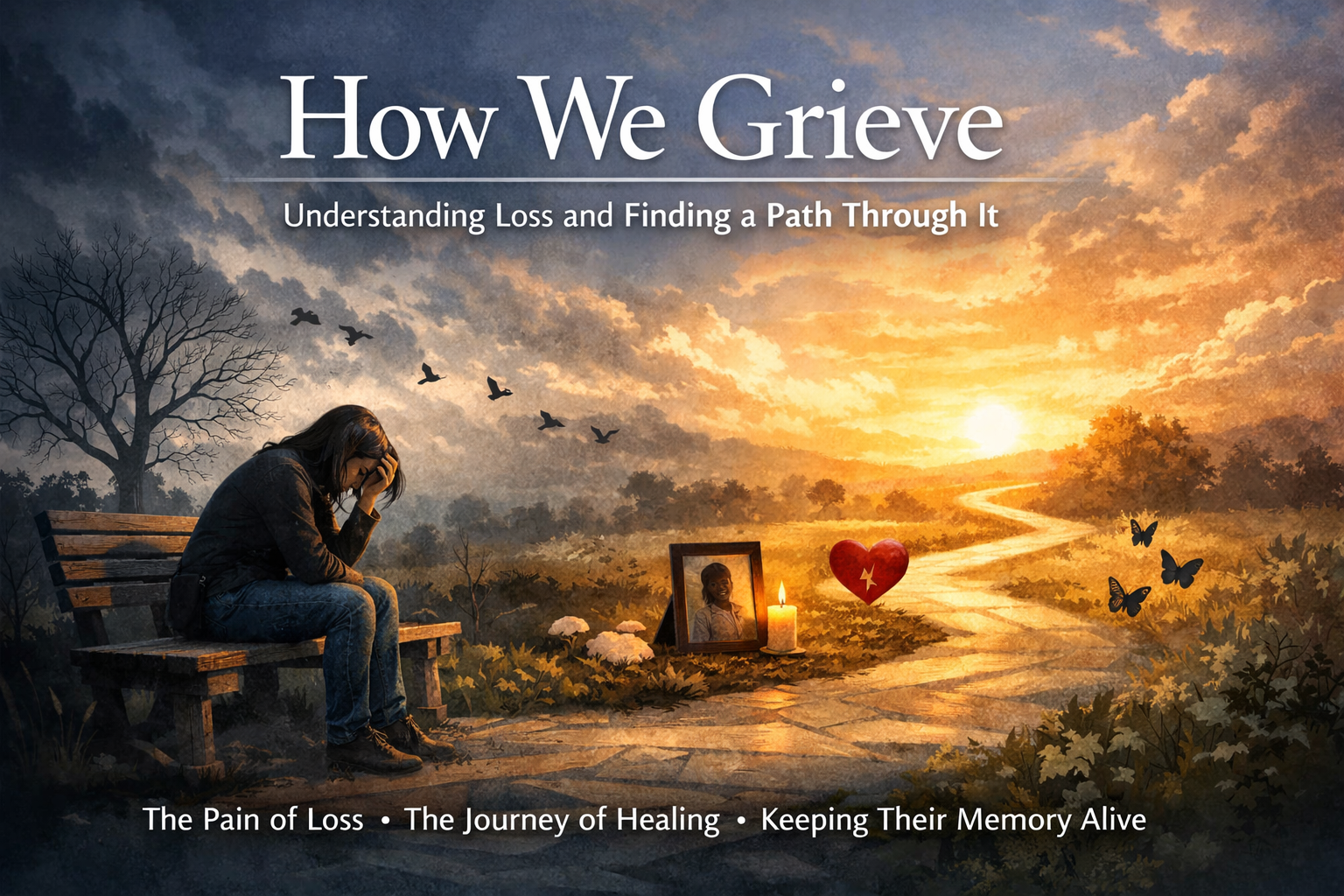
Grief is the price of love. When someone we care about dies, the bond that connected us does not simply switch off — it keeps reaching for them, finding absence instead of presence. That reaching is what grief is.
It is also one of the most misunderstood human experiences. We are surrounded by cultural scripts that tell us grief has stages, timelines, and predictable endpoints. Most of those scripts are wrong, or at least deeply incomplete. This guide is an attempt to offer something more honest and more useful.
What Grief Actually Is
Grief is not a single emotion. It is a process — a reorganization of the self in response to an irreversible loss. When someone central to your life dies, the loss ripples outward through your identity, your daily routines, your sense of the future, and your understanding of the world.
If you're looking for a foundational overview of what grief is, that guide covers the essentials. Here we go deeper into how it unfolds.
Psychologist J. William Worden describes grief not as something that happens to you passively, but as a set of tasks you move through: accepting the reality of the loss, processing the pain, adjusting to a world without the person, and eventually finding ways to maintain a connection with them while building a new life forward. None of these tasks has a fixed completion date.
Grief is also physiological. Neuroscientific research shows that social loss activates the same brain regions as physical pain. The "broken heart" is not a metaphor — bereavement is associated with elevated cortisol, disrupted sleep architecture, immune suppression, and in extreme cases, a condition called Takotsubo syndrome, where intense emotional stress can cause the heart muscle to weaken temporarily.
This is why grief is exhausting. The body is working.
Why Grief Is Not Linear
In 1969, psychiatrist Elisabeth Kübler-Ross published On Death and Dying, introducing a model of five stages: denial, anger, bargaining, depression, and acceptance. The model was originally based on interviews with terminally ill patients about their own dying — not with bereaved survivors — but it became the dominant framework for grief in popular culture.
The problem is that real grief rarely follows a sequence. A large-scale study published in the Journal of Loss and Trauma found that most bereaved people do not move through discrete stages at all. They oscillate. They feel acceptance on a Tuesday and raw devastation on a Wednesday. They go months without crying and then fall apart during a grocery trip when they see the brand of cereal their mother always bought.
Stroebe and Schut's Dual Process Model offers a more accurate picture: the bereaved move back and forth between loss-orientation (focusing on the grief, missing the person, processing the pain) and restoration-orientation (adapting to life, learning new roles, building new routines). This oscillation is not a sign of instability. It is the mechanism of adaptation.
The implication is important: wherever you are in grief — whether it has been three weeks or three years, whether you cry every day or have not cried at all — you are not doing it wrong.
Different Types of Loss
Not all losses are experienced equally, and it helps to understand why some feel particularly complex.
Sudden and traumatic loss
When someone dies without warning — through accident, sudden illness, suicide, or violence — there is no time to prepare. The shock can delay the grief response for weeks or months. The bereaved may also carry trauma alongside grief, which requires separate attention: intrusive memories, hypervigilance, avoidance of reminders.
Loss after a long illness
When death follows a prolonged illness, some grief work often begins before the person dies — a process called anticipatory grief. The bereaved may arrive at the moment of death already exhausted and partly processed, which can make the relative calm afterward feel confusing or guilt-inducing.
Loss of a parent
Losing a parent is described by many as losing the person who most believed in your existence. Even when the relationship was complicated or the death was expected, there is often a developmental shift — a new awareness of one's own mortality, a sense of becoming the older generation.
Loss of a child
Child loss is widely regarded as one of the most devastating forms of grief. It violates the expected order of life and often carries unique social dimensions — parents may find that others are unsure how to speak to them, or that the bereaved couple processes grief very differently from each other.
Loss of a partner or spouse
The death of a long-term partner disrupts not just a relationship but an entire infrastructure of daily life, shared identity, and future plans. Many bereaved partners describe feeling as though a part of themselves has been amputated.
Disenfranchised grief
Disenfranchised grief — a term coined by Kenneth Doka — refers to grief that is not socially recognized or validated. This includes grief after losing an ex-partner, a close friend, a pet, a pregnancy, or a relationship that others did not know about. Because the loss goes unacknowledged, the bereaved often suffer without support. If your grief feels invisible to others, that invisibility is real — and it matters.
How Grief Shows Up in the Body and Mind
Grief is not purely emotional. It manifests across the whole person.
Emotional
- Deep sadness and longing for the person
- Anger — at the circumstances, at others, at the person who died for leaving,
at oneself
- Guilt and regret, including the relentless inventory of things said and unsaid
- Anxiety and a heightened sense of the fragility of life
- Relief, especially after prolonged suffering — and the guilt that often
accompanies it
- Numbness, a protective buffer against overwhelming pain
Cognitive
- Difficulty concentrating — sometimes called "grief fog" or "widow brain"
- Forgetfulness and confusion
- Intrusive thoughts and replaying the circumstances of the death
- A sense of unreality, as though the death is not fully true
Physical
- Fatigue that sleep does not fully resolve
- Changes in appetite — either a loss of hunger or seeking comfort in food
- A physical ache in the chest, throat, or stomach
- Disrupted sleep, including waking at 3am with a rush of sadness
- A lowered immune system; bereaved people get sick more easily
Behavioral
- Withdrawing from social contact
- Avoiding reminders of the person, or conversely, being unable to disturb
anything they touched
- Changes in work performance or creative output
- Drinking more, or turning to other substances
All of these responses are normal within the acute phase of grief. They become concerning only if they are prolonged, intensifying rather than fluctuating, or beginning to dominate every dimension of life.
The Difference Between Grief and Depression
Grief and depression share many surface features — low mood, changes in sleep and appetite, withdrawal, loss of pleasure. But they are distinct.
In grief, the low feelings are typically connected to the loss. They come in waves, often triggered by reminders of the person. Even in the depths of grief, most people retain the capacity for moments of positive emotion — laughter, warmth, joy — when the circumstances allow.
In clinical depression, the low mood is more pervasive and disconnected from specific triggers. There is often a persistent sense of worthlessness, a belief that things will never improve, and a flat inability to feel pleasure even briefly.
The distinction matters because the two conditions call for different responses. Grief is not a disorder to be treated but a natural process to be supported. Depression, whether it emerges independently or is triggered by loss, benefits from clinical intervention.
If you are unsure which you are experiencing, a conversation with a GP or mental health professional is a good starting point.
What Actually Helps
Allow the grief rather than managing it
Our cultural instinct is to resolve discomfort quickly. Grief resists this. The research consistently shows that attempting to suppress grief — staying busy, not thinking about it, "being strong" — tends to prolong and complicate it. Allowing the waves to come, sitting with the sadness without trying to fix it, is not weakness. It is the work.
Talk about the person
One of the things bereaved people fear most is that the person they lost will be forgotten. Speaking their name, sharing stories, laughing at memories — these acts keep the person present and signal to others that it is safe to do the same. Research by grief therapist William Worden shows that the bereaved who maintain a symbolic ongoing connection with the deceased tend to adapt more healthily than those who try to "let go."
Accept practical support
In the acute phase of grief, ordinary tasks become enormous. Cooking, laundry, childcare, administration — these can feel insurmountable. Accepting help with these things is not an imposition on others. For most people, being able to help is a relief. Let them.
Stay connected — even when it is difficult
Isolation reinforces grief and can tip it toward complicated grief or depression. You do not need to perform recovery or explain yourself. Simply being in the presence of people who care about you has a measurable effect on mood and nervous system regulation.
Maintain small rituals of remembrance
Many bereaved people find that small, deliberate acts of memory help: lighting a candle on the person's birthday, visiting a place they loved, cooking a meal they always made. These are not about staying stuck. They are about maintaining a living relationship with someone who is no longer alive in the same form.
Move your body
Physical activity is one of the few interventions with consistent evidence for reducing the intensity of grief. A walk, not a marathon. The point is to interrupt the ruminative pull of grief with the experience of being in a body that can still move through the world.
What Doesn't Help
Timelines and comparisons
"You should be feeling better by now." "At least they lived a long life." "Others have it worse." These phrases — however well-intentioned — communicate that the bereaved person's grief is excessive or wrong. There is no expiry date on grief. There is no hierarchy of loss. Every loss is the loss of a specific, irreplaceable person.
Silence out of discomfort
Many people avoid mentioning the deceased because they are afraid of saying the wrong thing and making the bereaved person more upset. The opposite is almost always true. The bereaved person is already thinking about the person they lost — all the time. What they need is permission to speak about them. A simple "I've been thinking about you and about [name]" is enough.
Premature problem-solving
Grief is not a problem. It does not need to be solved or optimized. Jumping too quickly to "have you tried therapy?" or "you should think about getting out more" can communicate that the grief itself is the problem rather than the loss. Presence matters more than solutions.
Supporting Someone Who Is Grieving
If someone you care about is bereaved, here is what actually helps:
Show up consistently, not just at the beginning. The first few weeks often bring a wave of support. The weeks after — when most people have returned to their lives — are often when grief intensifies. A text three months later that says "I'm still thinking of you" can mean more than a hundred condolence cards.
Say the name. Ask about the person who died. Share a specific memory of them if you have one. Do not make the bereaved person feel they have to carry the loss alone or protect you from it.
Offer concrete help, not open offers. "Let me know if you need anything" places the burden back on the bereaved person to ask. "I'm bringing dinner on Thursday — does six o'clock work?" is something they can say yes to.
Follow their lead. Some grieving people want to talk constantly. Others need distraction and normality. Some need silence. Ask what they need right now rather than assuming.
Grief and Children
Children grieve differently from adults and need age-appropriate honesty and support.
Young children often process grief in bursts — they may seem devastated for ten minutes and then ask to go play. This is not a sign they are not affected; it is a sign their emotional capacity requires breaks. The grief tends to resurface at developmental milestones — starting school, hitting puberty, graduating, getting married — when the absence of the person is felt anew.
The most important things for grieving children are:
- Honest, clear language — avoid euphemisms like "passed away" or "gone
to sleep" that can cause confusion or fear
- Consistency and routine, which signals that the world is still safe
- Permission to feel whatever they feel — including anger, and including
being happy sometimes
- An open invitation to ask questions and speak about the person
Grief counseling specifically designed for children exists and can be transformative. If a child's behavior changes significantly and persistently — regression, school refusal, prolonged withdrawal — professional support is worth seeking.
When Grief Becomes Complicated
Most grief, however painful, eventually integrates. But for some people — estimates suggest around 10% of bereaved adults — grief becomes prolonged and debilitating. This is called Prolonged Grief Disorder (PGD), also known as complicated grief, and it is now recognized in both the DSM-5-TR and ICD-11.
Signs that grief may have become complicated:
- Persistent and intense longing for the person that does not fluctuate or
soften over many months or years
- Difficulty accepting the reality of the death
- Bitterness or anger about the loss that remains overwhelming
- Feeling that life is meaningless or empty without the person
- An inability to engage in normal daily activities or relationships
- Avoiding all reminders of the person, or conversely, being unable to engage
with the world at all
PGD is distinct from clinical depression and requires specific therapeutic approaches. Complicated Grief Treatment (CGT), developed by M. Katherine Shear at Columbia University, has shown strong evidence in clinical trials. It combines elements of cognitive behavioral therapy with grief-specific techniques, and significantly outperforms standard depression treatment for this population.
Seeking help for complicated grief is not a failure. It is a recognition that some pain requires specialized support — just as a complex fracture needs more than rest.
The Long Arc: How Grief Changes Over Time
Grief does not end. But it changes.
In the early phase — typically the first six to twelve months — grief tends to be acute and consuming. The loss is everywhere. Even moments of ordinary life carry the weight of absence.
Over time, for most people, the waves of grief become less frequent, though not necessarily less intense when they come. The bereaved begin to rebuild a life around the loss rather than through it. New routines develop. New relationships form. New meaning emerges, though usually not the same meaning as before.
What does not change is the love. The connection with the person who died does not need to be severed in order to heal. Many bereaved people find that their relationship with the deceased transforms into something more internal — a voice, a presence, a set of values and memories that continue to shape how they live. This is sometimes called continuing bonds theory, and the research supports it as a healthy form of adaptation.
The person you lost is not erased. They become part of who you are.
A Note on Grief and Meaning
Viktor Frankl, a psychiatrist who survived the Nazi concentration camps, wrote that the last human freedom is the freedom to choose one's attitude toward suffering. He did not mean that grief should be reframed positively or that loss should be minimized. He meant that even within the worst pain, humans have a capacity to find meaning — and that this capacity matters.
For some bereaved people, meaning comes through honoring the person's legacy: a donation made in their name, a commitment to something they believed in, a story kept alive. For others, it comes through the relationships that grief has deepened. For others still, it comes through simply surviving — discovering a resilience that was not known to exist before.
There is no obligation to find meaning in loss. But for many people, meaning becomes part of how the wound eventually heals.
Keeping Memory Alive
One of the most concrete things any of us can do — both for our own grief and for the people who come after us — is to create and preserve a record of the person's life.
Photographs, stories, the sound of their voice, the details that made them uniquely themselves: these are not just sentimental. They are the raw material of memory, and memory is the form that love takes after death.
At Memoriance, we build tools to help families create lasting memorial pages — places where a person's story, photos, and the words of those who loved them can live indefinitely. Not as a monument to the end of their life, but as a living record of the whole of it.
Because grief and memory are not opposites. They are two sides of the same love.