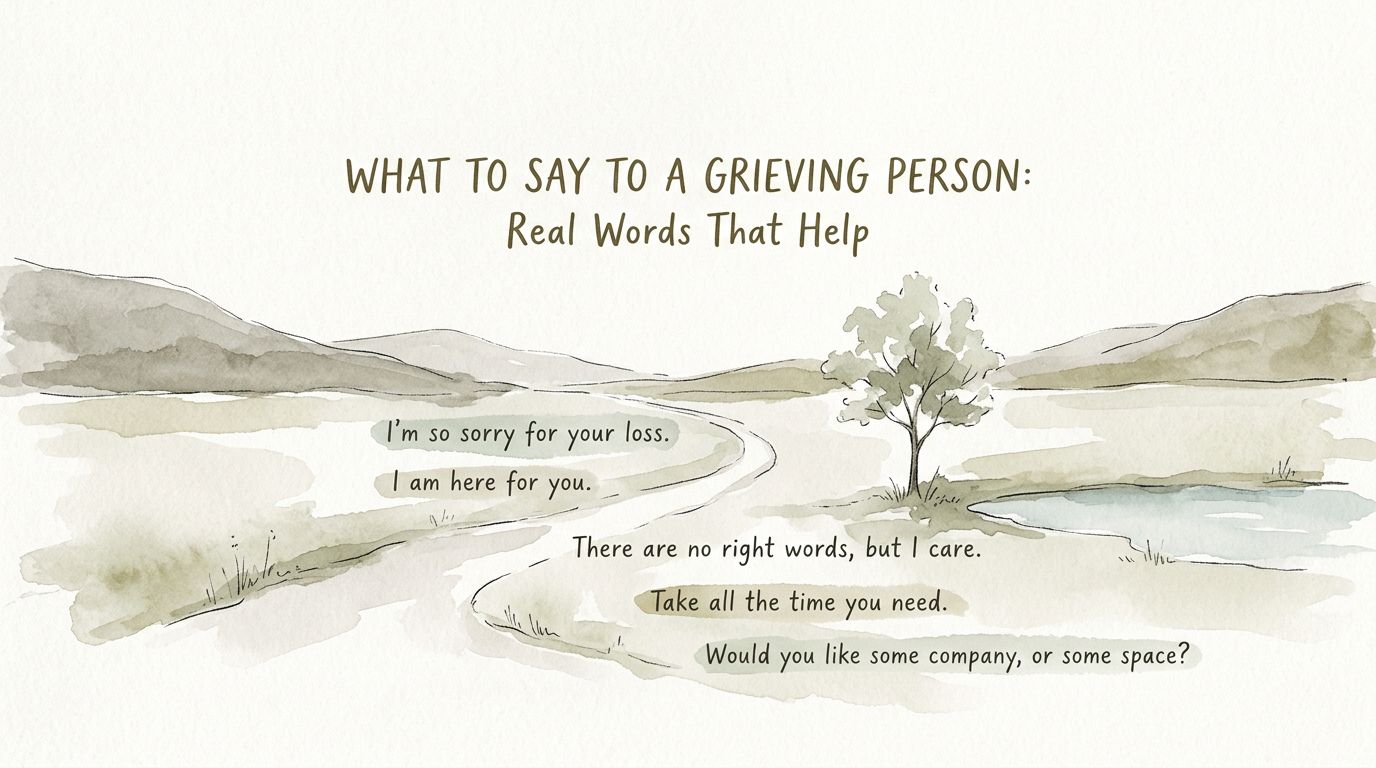
The fear of saying the wrong thing keeps a lot of people silent. But silence from people who matter often feels worse than clumsy words. Most bereaved people will tell you that what hurt them most wasn't an awkward condolence; it was friends and colleagues who disappeared entirely.
If you're searching for what to say to a grieving person, you probably don't need abstract comfort theory. You need phrases you can actually use, an honest look at what tends to land badly, and the confidence that imperfect presence is still worth offering.
You Don't Need the Right Words
What grieving people tend to remember isn't whether someone found exactly the right thing to say. It's whether they showed up — and kept showing up.
When nothing useful comes to mind, naming that honestly is enough. "I don't know what to say, but I'm really glad I know" lands better than silence. So does "I can't imagine what you're going through, and I'm not going anywhere." These aren't polished phrases. They're real ones — and real is what people in grief tend to respond to.
What almost never helps is avoiding the subject altogether. Changing the topic, keeping things cheerful, or acting as though nothing has happened may feel kinder in the moment, but it usually reads as discomfort — as if the death is too uncomfortable to acknowledge. Most bereaved people notice.
What to Say: Phrases for Different Moments
The most helpful things you can say tend to do at least one of three things: acknowledge the loss without minimising it, offer something specific rather than vague, or invite conversation without demanding it. Here's what that looks like at different points.
When you first hear the news
- "I'm so sorry. I'm really glad you told me."
- "I don't have the right words — I just want you to know I'm here."
- "This is such awful news. Is there anything you need right now?"
- "I've been thinking about you. Take all the time you need."
You don't need to say much. A short, honest sentence is usually better than a long one full of qualifications.
In the weeks that follow
- "I've been thinking about you. No need to reply — I just wanted you to know."
- "I'm heading to the shops this afternoon. Can I drop something round?"
- "Would you want company this week, or would you rather have space? Either is absolutely fine."
- "I keep thinking about [name]. Would you want to talk about him sometime?"
Specific offers are almost always better than open-ended ones. "Let me know if you need anything" puts the burden on the grieving person to manage your availability. Offering something concrete — a meal, a walk, a particular afternoon — is easier to accept.
For support framed around a close friendship, this guide on sympathy messages for a friend has additional ideas for reaching out at different stages.
When they bring up the person they've lost
- "Tell me about her."
- "What was he like?"
- "What do you miss most?"
- "I'd love to hear more about her, if you feel like talking."
This category matters more than most people realise. Many well-meaning friends change the subject when someone in grief mentions the person who died — afraid of making them sad, or of not knowing what to say next. But bereaved people are already thinking about them, almost constantly. Being asked to talk about the person they loved is often a relief.
What Not to Say — and Why
Some phrases feel supportive to the person saying them but land badly for the person hearing them. Knowing why helps you find better alternatives.
"They're in a better place"
Even if both of you genuinely believe this, it doesn't make the absence less painful. It can feel as though the loss is being minimised, or as though the grieving person ought to feel comforted when they don't.
"I know how you feel"
You probably don't — not exactly. Grief is shaped by the specific relationship, the circumstances of the death, and a hundred other things that are unique to that person. "I can only imagine how painful this is" is both more honest and more comforting.
"Everything happens for a reason"
This one can feel genuinely hurtful after a sudden or traumatic loss. It implies the death was somehow meant to happen — which many bereaved people find impossible to hear, and which may not align with what they believe at all.
"At least..."
Beginning a sentence with "at least" almost always ends badly. "At least she lived a long life." "At least you're young enough to have more children." Even when said with real care, these comparisons tend to feel dismissive — as though the loss should be weighed against a silver lining.
"You need to stay strong"
Bereaved people are already managing enormous pressure. Being told to stay strong can feel like an instruction to suppress what they're feeling — which is the opposite of what helps most people through grief.
"Let me know if you need anything"
This is well-meant, but it puts the labour on the grieving person to identify their needs and then ask for help with them. Offering something specific is almost always easier to accept.
When Words Don't Come
Sometimes you'll be with someone in real pain and nothing useful will come to mind. That happens to almost everyone, and it doesn't mean you've failed.
Say so. "I don't have words, but I'm not going anywhere" is honest and reassuring — and far better than a long speech that doesn't quite land.
Sit quietly. Not every moment needs filling. Staying present without speaking is its own form of support. Many bereaved people say they needed someone to just be there more than they needed advice.
Ask before touching. Some people find a hand on the arm, or a hug, genuinely comforting. Others don't. A gentle "would a hug help?" is kinder than assuming.
Follow their lead. If they want to talk, listen without redirecting. If they want distraction, offer it. If they want you to leave, let them say so.
Supporting Someone Long After the Loss
The weeks immediately after a death tend to be full of contact — messages arrive, people visit, flowers pile up in the kitchen. Then, usually around six to eight weeks later, most of that fades. That's often when the heavier part of grief arrives.
Some of the most meaningful support you can offer comes later, not sooner:
- A message on the anniversary of the death — even a short one
- Mentioning the person who died by name months later, which signals that you haven't forgotten
- Checking in around dates that will be difficult: Christmas, birthdays, the first anniversary
- Asking how they are, specifically — "How are you really doing?" invites a more honest answer than "How are you?"
A text that says "Thinking of you today — no need to reply" can mean more than a dozen messages in the first fortnight. And when you use the name of the person who died, you're telling the bereaved person something important: that their loved one still exists for you too.
If you're putting something in writing — a note, a card, or a longer message — this guide on what to write in a bereavement card covers language for different relationships and moments. For more formal expressions of sympathy, condolence messages offers examples you can adapt for cards and letters.
A Final Word
There's no script for supporting someone who is grieving. Some days your company will be wanted; other days it won't. The offer still matters, even when it's declined — it tells the person you're thinking of them, which is often enough.
What almost everyone in grief wants is to feel that the person they've lost still matters to other people. When you say their name, ask to hear a story about them, or simply stay present in the months when most others have drifted away, you're giving something that counts — even if you can't quite find the words for it.
If the person you're supporting doesn't yet have a place where friends and family can gather memories, photos, and tributes, a memorial page gives them that permanent space. You can begin a memorial on Memoriance for the price of a bouquet of flowers — something that lasts long after the flowers are gone.