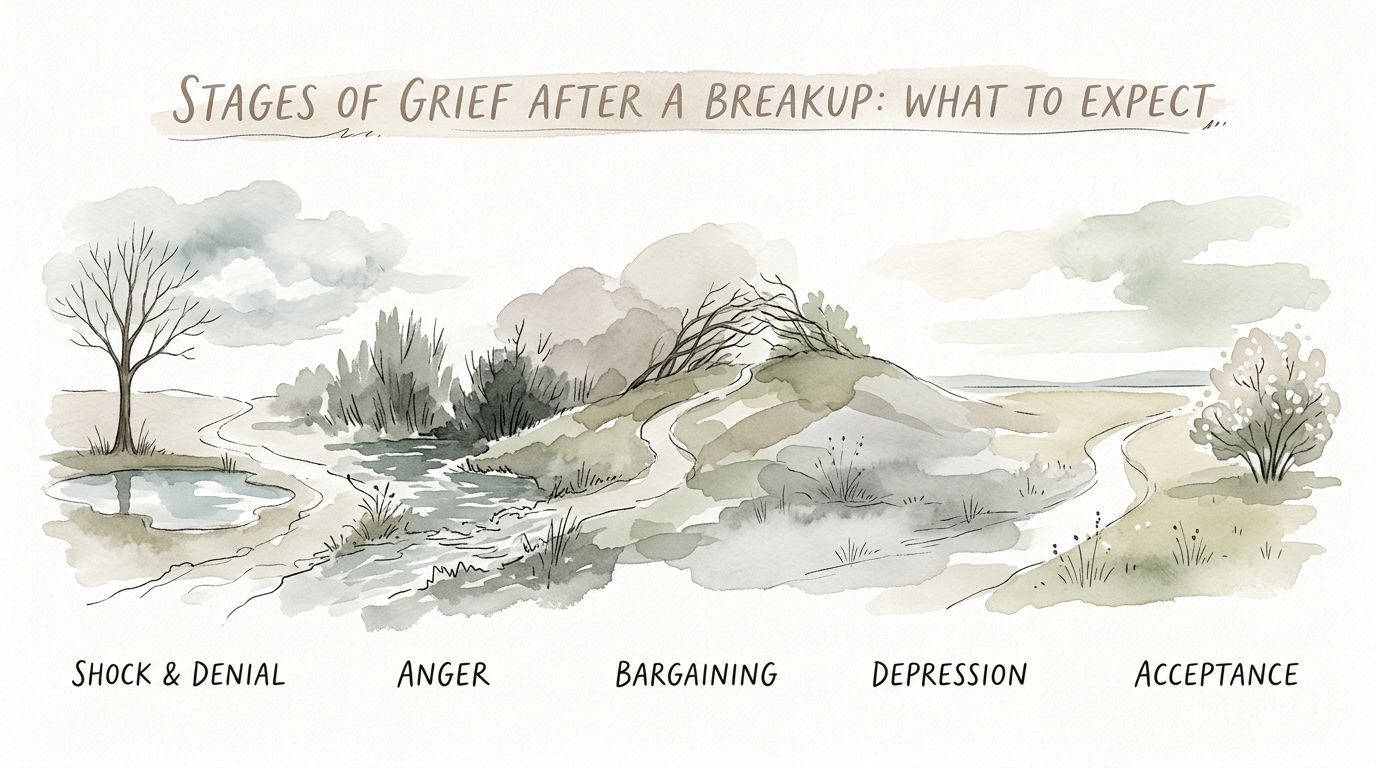
The end of a relationship can hit harder than people expect it to. You might find yourself cycling through shock, anger, hope, and despair — sometimes all in a single afternoon. These feelings are not a sign that you are being dramatic. Grief is a natural response to loss, and a breakup is a real loss: of a person, a future, a version of your daily life that no longer exists. The five stages of grief, first described by psychiatrist Elisabeth Kübler-Ross, do not apply only to death. They appear after the end of relationships too, and understanding them can make a bewildering experience feel a little less like you are losing your mind.
Why a breakup can feel like grief
Most people expect to feel sad after a breakup. Fewer expect the particular weight of grief: the physical heaviness of it, the way it arrives in waves, the exhaustion that does not lift after a night of sleep.
The reason is straightforward. Grief is what happens when something we were deeply attached to disappears from our life. A relationship, especially a long or serious one, carries shared routines, shared plans, shared identity. Losing it means losing your future as you had imagined it, your sense of being someone's person, and often your whole social world alongside it. The loss is layered in ways that take time to surface.
That loss is real. It does not need to measure up against bereavement to deserve care and time. Understanding what grieving means as an ongoing process, not a single event with a clear endpoint, is often the first step toward giving yourself the space you actually need.
The five stages of grief after a breakup
The five stages (denial, anger, bargaining, depression, and acceptance) were never intended to work as a straight line. Kübler-Ross herself said as much. In the context of a breakup, they are less a sequence than a weather system: you will spend time in each, revisit some, and skip through others without warning. Knowing what each stage looks and feels like makes them easier to recognise when they arrive.
Denial
In the first hours or days after a breakup, the mind often refuses to fully take in what has happened. You might replay the conversation looking for the part where you misunderstood. You might half-expect a message saying it was all a mistake. You might carry on as usual, going to work, making plans, keeping the routine intact, because the full reality has not settled yet.
Denial is not weakness or self-deception. It is a way the mind protects itself from being overwhelmed all at once. It tends to lift gradually as reality accumulates through small, ordinary moments: waking up alone, seeing an empty chair, reaching for your phone to share something before remembering.
Anger
When the numbness lifts, anger is often what rushes in. It may be directed at your ex, for leaving, for not trying harder, for things you are only now seeing clearly. It may turn inward as self-blame. It may come out sideways, at friends who say the wrong thing or at situations that have nothing to do with the breakup at all.
Anger is a signal that you are starting to process what happened. It is uncomfortable, but it is healthier than staying numb. Let yourself feel it without acting on every impulse it generates. The late-night message rarely says what you mean; it usually just makes the following day harder.
Bargaining
This is the stage that catches people off guard, because it does not always announce itself as bargaining. Sometimes it looks like sending a long message at night. Sometimes it looks like convincing yourself that if you just changed one particular thing, the relationship could be repaired. Sometimes it is running the whole history back through your head, identifying every moment where things might have gone differently.
Bargaining is the mind's attempt to regain control over something that feels entirely out of your hands. Most of the questions it generates cannot be answered cleanly, and most of the scenarios it plays out will not happen. Sitting with that uncertainty is one of the harder parts of getting through a breakup, and one of the most necessary.
Depression
At some point the bargaining quiets and the weight of what you have lost becomes harder to avoid. For most people, this is not clinical depression — though for some, a breakup can trigger or worsen existing mental health difficulties, and it is worth speaking to your GP if you are struggling to function day to day.
For many people, this stage looks like low energy, withdrawal, tearfulness, and a general flatness. Familiar things feel less interesting. The future feels blank or formless. This stage often coincides with others losing patience with your grief. You are not being dramatic. You are grieving, and grief takes the time it takes.
Acceptance
Acceptance does not mean you are glad it ended, or that it stopped mattering. It means you have started building a version of life that does not depend on the relationship returning. You can think about your ex without the same spike of pain. You can picture a future, even if it looks nothing like the one you had planned.
Acceptance tends to arrive gradually and unevenly. You will feel it one afternoon and then not again for a week. That is normal. The gap between those moments slowly narrows, and the forward-looking version of you starts to feel more real than the one still looking back.
What makes breakup grief harder to process
A few things about breakup grief make it more complicated than it might first appear, and understanding them can explain why it sometimes feels heavier than expected.
The person is still alive. When someone dies, their absence is permanent and the world acknowledges it. When a relationship ends, your ex is out there somewhere, potentially visible on social media, potentially moving on in ways you can see. There is no social ritual for breakups, no clear moment of collective acknowledgement, which leaves the grief without a container.
The questions often stay unanswered. Breakups, especially gradual ones or ones that came without a single clear cause, can leave you without a coherent narrative of what happened. Grief tends to look for reasons, and ambiguity makes that harder. Some questions will never be resolved, and part of acceptance is learning to carry them without needing them answered first.
Your shared life carries on without you. Mutual friends, shared routines, familiar places: these hold associations that surface unexpectedly for months. The coffee shop, the playlist, the group chat that quietly shifts. These are small losses that accumulate and arrive on their own schedule.
Social support thins out faster. People are less likely to bring you meals, offer time off, or check in weeks later when the grief has gone quiet and strange. This is partly why breakup grief can feel disproportionately isolating, even when you have people around you who genuinely care.
What actually helps
There is no clean route through, but some things genuinely make a difference.
- Give yourself the patience you would give a friend. If someone you cared about was in your position, you would not tell them to snap out of it. Extend that same consideration to yourself.
- Limit contact where you can. Staying connected out of hope or habit makes the early stages significantly harder. Reducing contact, even temporarily, tends to shorten the grieving period rather than extend it.
- Expect the stages to be non-linear. A good week followed by a hard day is not a setback. It is how grief moves.
- Be deliberate about social media. Seeing your ex's life play out during a raw period is not neutral. Muting or unfollowing, at least for a while, makes a real difference for most people.
- Keep up the small basics. Sleeping, eating, moving your body. Not because they fix grief, but because grief is much harder to carry in a depleted body.
- Let people in, even a little. You may not want to talk about it in detail, and you do not have to. Staying connected to other people, even just for something ordinary, helps more than isolation tends to.
If you are also managing the practical fallout of a breakup (shared finances, rented accommodation, children, mutual commitments), know that the logistical grief is part of the emotional grief. The most difficult breakups are often those where both are happening at once. The five stages of grieving were developed in the context of death, but everything they describe about the mind and body's response to loss applies here too.
When to reach out for more support
Most people come through a breakup without professional support, even when it is genuinely hard. But some signs suggest it is worth speaking to a GP, therapist, or counsellor.
- You are struggling to function at work or in daily life beyond the first few weeks
- You are using alcohol or substances to manage how you feel
- You are having thoughts of self-harm
- The feelings are not easing after several months
You do not need to be in crisis to seek support. Grief of any kind can affect your concentration, energy, and your ability to function at work, and that is a legitimate reason to reach out. In the UK, your GP is the right first point of contact, and many areas offer free counselling through the NHS or organisations like Cruse.
Moving through it
The stages of grief after a breakup are not a checklist and not a timeline. They are a loose description of the emotional territory you will move through — not necessarily in order, not at any particular pace, and not in a way that looks the same for any two people. What they offer is a framework for understanding what is happening inside you while it is happening. That understanding does not end the pain, but it can make it feel less like something is wrong with you for feeling it.
Be patient with yourself. The feelings are real, and they will shift.
Grief takes many forms. If you have also lost someone to death and want a lasting place to honour them, Memoriance lets you create an online memorial that keeps their memory close, for the price of a bouquet of flowers.