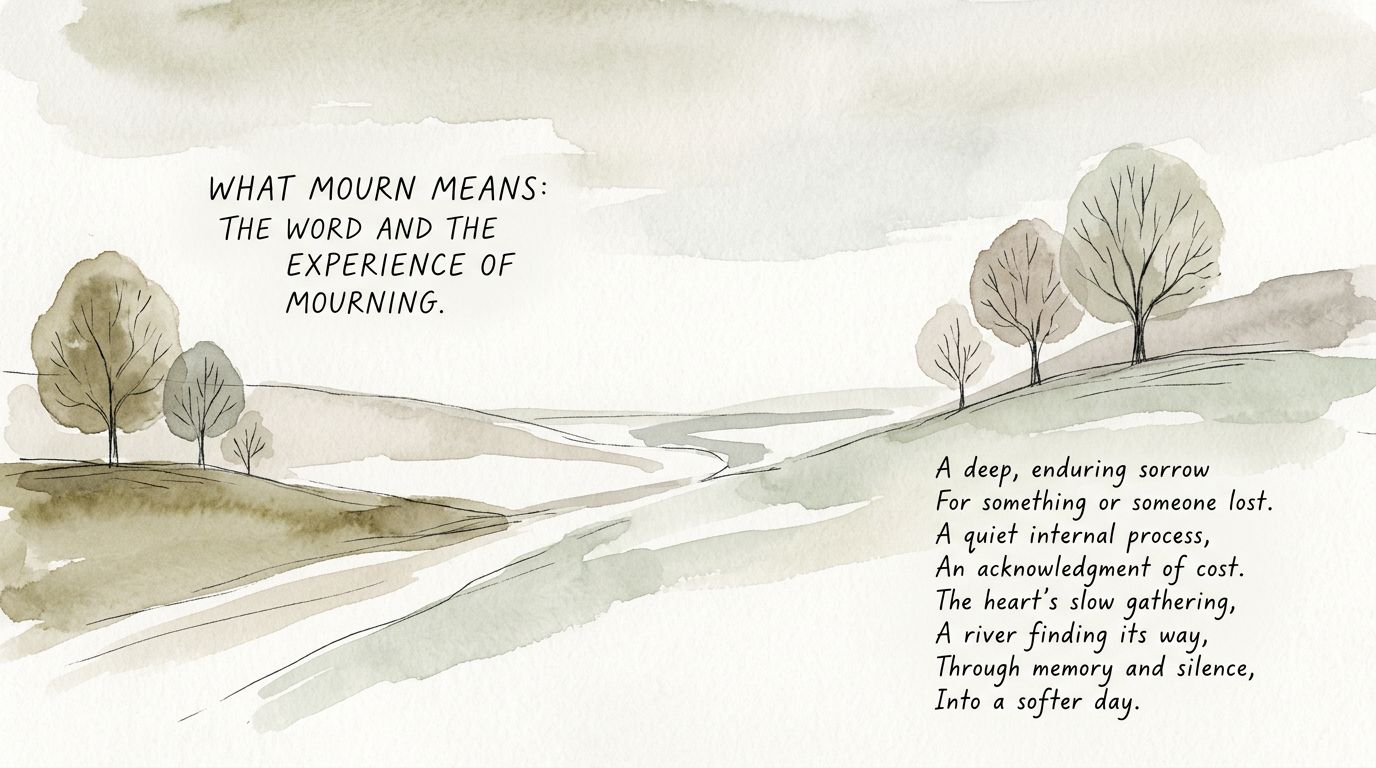
To mourn is to grieve — but the word carries more weight than that single sentence captures. If you have found yourself using the word "mourning" and wondered what it really means, or if you are in the middle of a loss and trying to make sense of what you are feeling, this guide walks through the meaning of mourn, how mourning differs from grief, and what mourning tends to look like in real life.
The definition of mourn
Mourn is a verb. To mourn means to feel and express deep sadness over a death or loss. Its Old English root, murnan, held meanings of both sorrow and anxiety — which is fitting, because mourning rarely travels without worry alongside it.
You can mourn a person. You can also mourn a pet, a pregnancy, a relationship, or something less tangible — a version of yourself you thought you would become, a future that is no longer possible. The word applies wherever there is loss and a genuine attachment to what has gone.
Common word forms:
- Mourn — the verb: "She still mourns her father."
- Mourning — the noun or present participle: "He is in mourning." / "They are mourning their loss."
- Mourner — a person who grieves, especially at a funeral
- Mournful — the adjective: a mournful silence, a mournful tone
Mourning and grief: what is the difference?
People use mourning and grief interchangeably, and there is nothing wrong with that. But there is a distinction worth knowing.
Grief is the internal experience — the emotions, the thoughts, the physical sensations that come with losing someone. It is what happens inside you. Mourning is often described as the outward expression of grief: the rituals, the behaviours, the public acknowledgement of loss. This is why we talk about a "mourning period" or "mourning clothes." Mourning is grief made visible.
In practice, they overlap. You can be deep in mourning while your grief is entirely private. And grief can pour out of you in ways that look nothing like traditional mourning customs. If you want to understand more about the emotional side of this, what grieving really means covers the inner experience in detail.
What mourning actually looks like
Mourning has no single face. For some people it is crying at unexpected moments — hearing a song, passing a favourite restaurant, seeing someone who walks like the person they have lost. For others, mourning is quiet: a dullness that sits under daily life, a reaching for the phone to call someone who is no longer there.
You might experience:
- Sadness that arrives in waves, not a constant state
- Physical heaviness, fatigue, or difficulty concentrating
- Irritability or anger — at circumstances, at yourself, at others
- A strange flatness, as if colour has drained from ordinary things
- Moments of laughter or lightness, followed by guilt
None of these responses are wrong. Mourning is the mind and body processing something that cannot be resolved overnight.
How long does mourning last?
There is no single correct answer. Acute mourning — the most intense early period — tends to soften over months, though setbacks are normal. Anniversaries, milestones, and ordinary Tuesday mornings can all bring mourning back with full force.
The old idea that grief follows five neat stages — denial, anger, bargaining, depression, acceptance — is a framework, not a timetable. The five stages of grieving explains what those stages actually mean and, crucially, what they do not.
What most people find is that mourning does not end so much as change shape. The person you have lost does not leave your life — they move into a different place in it.
Mourning customs in the UK
In the UK, formal mourning customs — wearing black for a prescribed period, drawn curtains, black armbands — are largely historical. But communal mourning is still very much alive, even if it looks different today.
Funerals and memorial services are the most visible form of shared mourning. They allow people to grieve together, to acknowledge what has been lost publicly, and to offer one another the knowledge that someone is missed — that a life mattered. The people who attend, mourners, play a quiet but important role in that.
Beyond the funeral, mourning continues in smaller rituals: visiting a grave, keeping a photograph, cooking a recipe associated with someone, marking the anniversary of a death. These are all expressions of mourning, and they are all valid.
When mourning feels complicated
Sometimes mourning is straightforward in its difficulty — you lost someone you loved, and now you miss them. But mourning can also feel tangled.
You might feel relief alongside grief, particularly if someone died after a long illness. You might feel guilt about what was left unsaid. You might find that others do not recognise your loss as significant — a miscarriage, a colleague, an estranged parent — which can make mourning feel very lonely.
These experiences are all part of what mourning can be. There is no hierarchy of loss, and no grief too small to count.
What helps when you are mourning
There is no shortcut through mourning, but a few things tend to help:
- Let yourself feel it, rather than managing around it
- Talk about the person you have lost — their name, their habits, what you miss
- Allow other people in, even when it feels easier to close the door
- Be patient with yourself on difficult days
- Seek support if mourning begins to feel like it is swallowing everything
A place to hold what mourning means to you
Mourning is how we honour that someone mattered. It is not a weakness, and it is not a failure to move on — it is the natural weight of love when the person you love is no longer there.
If you have recently lost someone and are thinking about how to mark that loss in a lasting way, Memoriance lets you create an online memorial for the price of a bouquet of flowers — a permanent place to share their story, gather memories, and visit whenever you need to feel close to them.